
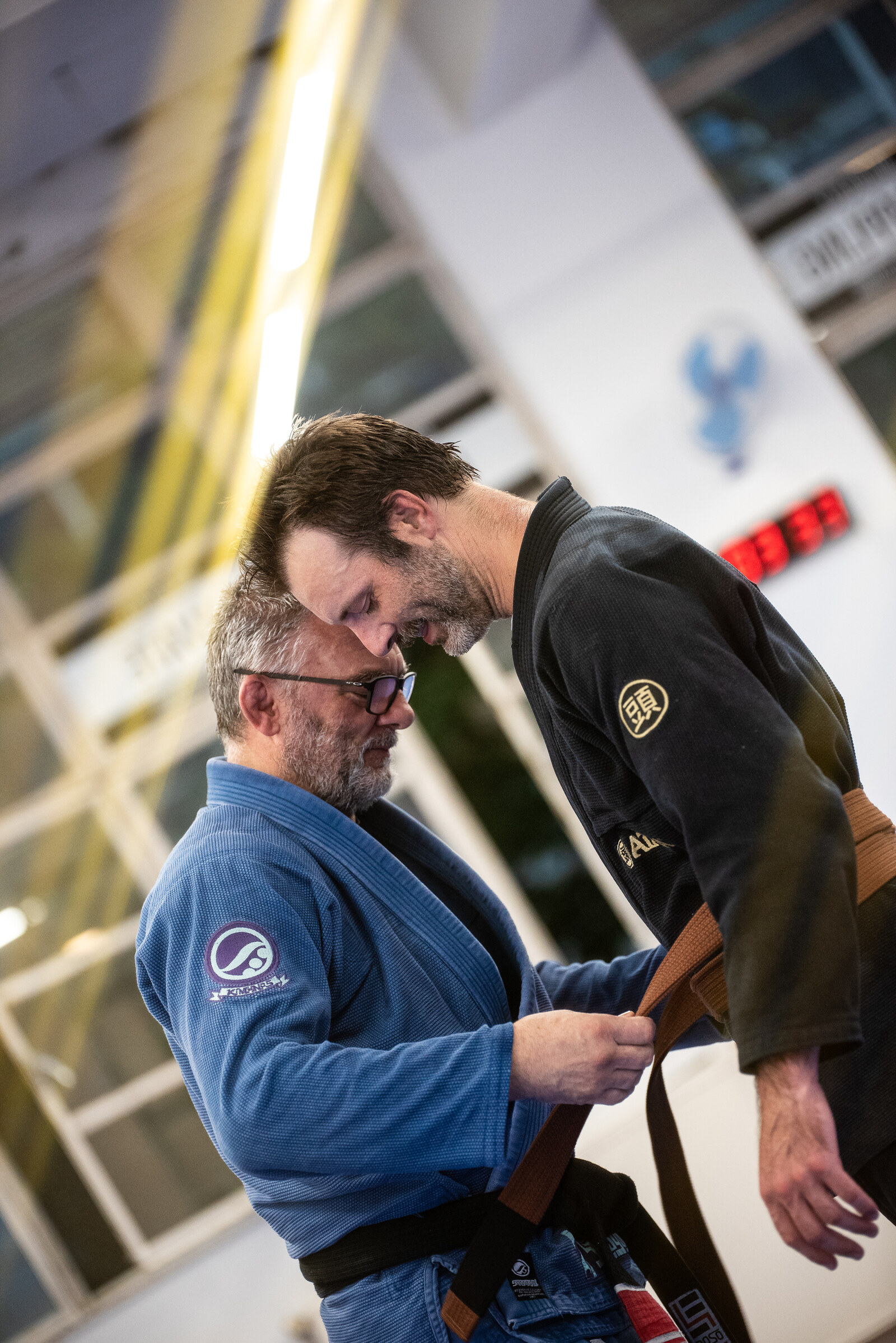
For adults, the BJJ belt system consists of five main belts: white, blue, purple, brown, and black. Years often pass between each stage – for us, a belt is a companion on a long journey, not a goal in itself.
Anyone starting Brazilian Jiu-Jitsu eventually asks the same questions: What belts exist in BJJ? How long does it take to reach black belt? When do I get my next belt?
The BJJ belt system is quite different from many other martial arts. While some sports hold multiple belt exams per year, in Brazilian Jiu-Jitsu the same belt color often stays with you for years. That's exactly what makes a BJJ promotion so meaningful.
At Hilti BJJ Berlin, we see the belt not as a goal but as a companion through a long development. A belt doesn't show how good someone was on a single day – it shows the progress made over a long period of time.
The order of BJJ belts
For adults, the Brazilian Jiu-Jitsu belt system consists of five main belts:
- White belt
- Blue belt
- Purple belt
- Brown belt
- Black belt
Years of regular training often pass between these belt levels. Each belt represents a new phase of development – technically, physically, and personally too. In Brazilian Jiu-Jitsu, it's not about reaching the next belt as quickly as possible. What matters far more is truly understanding movements and being able to apply them under resistance.
Why does a BJJ belt take so long?
This is probably the question we hear more than any other. The answer is actually quite simple: Brazilian Jiu-Jitsu can't be memorized. Knowing a technique and successfully applying it against an experienced training partner are two completely different things.
With every training session, your timing, balance, sense of pressure, and problem-solving ability improve. These skills don't develop over a few weeks – they develop over many years. That's why there are no shortcuts in BJJ, and that's exactly why a black belt is held in such high regard worldwide.
"Almost everyone goes through a phase at some point where nothing seems to work. In our experience as coaches, these phases are often the most important ones – because that's usually when your understanding of the sport actually shifts."
White belt – The fundamentals of Brazilian Jiu-Jitsu
The white belt marks the start of an exciting journey. It's not about collecting as many techniques as possible or winning every round. What matters far more is learning the basic positions, staying calm, breathing properly, understanding movement patterns, and getting used to grappling on the ground.
Many beginners initially believe they need to use as much strength as possible. Over time, almost everyone realizes that technique matters far more. The white belt is, above all, a time of learning, observing, and experimenting. If you're just getting started, our beginners page explains how getting started with us works.
Blue belt – The foundation becomes solid
The blue belt shows that the fundamentals are in place. Now you start connecting individual techniques with each other. Your defense becomes more reliable, and escaping bad positions gets easier and easier. Understanding of different guards, guard passes, and control positions grows noticeably too. Many people also start training more deliberately at this stage and begin developing their own game.
Purple belt – Your own game emerges
Many BJJ coaches say the purple belt is one of the most exciting belts of all. This is when everyone slowly develops their own style: some feel most comfortable playing guard, others prefer top positions, and others develop specific specialty techniques they become known for.
At the same time, responsibility grows too. Anyone who's been training longer naturally starts helping newer members, answering questions, and contributing to a positive training atmosphere.
Brown belt – Experience makes the difference
A brown belt already has a great deal of experience. Techniques flow into one another almost automatically, and movements become more efficient. It's less and less about knowing as many techniques as possible, and more about making the right decisions at the right moment.
Many brown belts also discover a passion for teaching. Explaining something to others is often a great way to learn it even more deeply yourself.
Black belt – Learning never stops
Outsiders often assume that reaching black belt means the goal has been achieved. In reality, a new chapter begins. A black belt knows one thing above all: there's always something more to learn. Even the smallest details can improve a technique, new training partners bring new challenges, and the sport keeps evolving.
That mindset is what makes a true black belt for us. Not the belt itself, but the willingness to keep learning.
How does grading work at Hilti BJJ Berlin?
We get this question regularly. We don't run a classic exam where you memorize techniques a few weeks in advance. Instead, we observe our members over a long period of time. Among other things, we look at:
- Technical development
- Understanding of positions
- Regular training
- Control over strength
- Respectful behavior toward training partners
- Willingness to learn
- Helpfulness on the mats
A promotion is therefore never a surprise after one good training session. It's the result of many months, or even years, of continuous development.
Do I need to compete to get my next belt?
No. Competing can be a great experience – it helps you learn under pressure and develop your own Jiu-Jitsu further. But it's not a requirement for grading. Many excellent BJJ practitioners have never competed. What matters is your development on the mats, not the number of medals. If you'd still like a taste of competition, take a look at our competition team page.
How long does it take to reach black belt?
There's no one-size-fits-all answer. Training frequency, prior experience, age, and individual development all play a big role. Anyone who trains consistently for several years will progress step by step. The focus should never be exclusively on the black belt – if you only wait for the next belt, you often miss the many small wins happening along the way.
Common beginner mistakes
Almost everyone goes through similar experiences at the start: using too much strength, giving up too quickly, comparing yourself to others, or only focusing on the next belt. Brazilian Jiu-Jitsu takes time – nobody masters the sport after a few months. Compare yourself to who you were six months ago instead. The belt will come eventually on its own; the skills you develop along the way stay with you for life.
Start your own belt journey.
Whether you're a complete beginner or already have martial arts experience – you're welcome at Hilti BJJ Berlin.
- Structured introduction
- More than 400 members
- Training in Berlin Wedding
It's not the belt that changes you. The path to it does.
At the start, almost everyone asks, "When do I get my next belt?" Later, the question usually becomes, "What can I learn today?" That's exactly what makes Brazilian Jiu-Jitsu so special to us.
Frequently asked questions about the BJJ belt system
How many belts are there in Brazilian Jiu-Jitsu?
For adults, there are five main belts: white, blue, purple, brown, and black.
Are there belt exams?
Most BJJ academies don't use formal exams. Instead, grading is based on long-term development.
Can I start BJJ as an adult?
Absolutely. Many of our members started Brazilian Jiu-Jitsu at 30, 40, or even 50 years old.
Do I need to be athletic?
No. Fitness develops through training. Curiosity, patience, and consistent training matter more.
Can anyone reach black belt?
In principle, yes. What matters most is persistence, consistency, and enjoying the process.

Frank Burczynski
Frank is Head Coach and a BJJ black belt at Hilti BJJ Berlin. He leads, among other things, our beginner onboarding classes and Gi Fundamentals training.
View coach profile →